Nanocrystalline vs CRGO vs Ferrite Cores: Efficiency, Losses & Best Applications
Last updated: April 2026
Who this comparison is for
- • Design engineers selecting core materials for transformers and inductors
- • Procurement managers evaluating cost vs performance trade-offs
- • Product managers optimizing power electronics for size and efficiency
What you'll learn
- • Technical comparison of magnetic properties and performance
- • Application-specific material selection criteria
- • Cost analysis and practical selection guidelines
Quick answer
- • Frequency < 1 kHz + cost priority → CRGO
- • ~10 kHz–100 kHz + size / loss at kHz matters → Nanocrystalline
- • High-frequency SMPS (often ~100 kHz+) → Ferrite (first default)
Choosing the wrong core material can significantly increase losses, create thermal problems, and lead to oversized designs. In some applications, the wrong choice can multiply losses several times over, forcing bigger heatsinks, derated current, or a magnetics rebuild late in the program.
For high-efficiency SMPS and inverter designs, start with our nanocrystalline and core products. Use our transformer turns and core selection tool to sanity-check turns, window fill, and core stress before you lock the BOM. If EMI is the pain point, read nanocrystalline vs ferrite for EMI filters for filter-specific trade-offs.
Overview
Choosing the wrong core material can significantly increase losses, create thermal problems, and force oversized magnetics. In some designs, the wrong alloy at your switching frequency wastes watts directly as core heat and pushes efficiency goals out of reach. This guide cuts through catalog noise and compares nanocrystalline, CRGO, and ferrite for real hardware: SMPS, inverters, line-frequency transformers, EV chargers, and current transformers (CTs), with clear calls on where each material wins or fails.
Core material sets your loss budget, CT phase error, thermal story, and mechanical volume. The engineering verdict:
- Nanocrystalline: usually the preferred choice when low core loss, compact size, and high efficiency matter in kHz magnetics (charger blocks, inverter magnetics, precision CTs, EMI stages that ferrite or steel cannot shrink without pain).
- CRGO silicon steel: the right call for 50/60 Hz utility-scale iron where high saturation and $/kVA beat power density; avoid it as a switching-frequency magnetics shortcut.
- Ferrite: often the practical low-cost choice for common SMPS shapes at HF, but less attractive when power density, loss, or CT accuracy requirements climb and you are fighting flux or temperature limits.
Ready to spec parts? Browse nanocrystalline and transformer core products for production paths. Size turns and core window with the core selection tool. If revenue-grade metering or protection CTs are on the schematic, read selecting nanocrystalline cores for current transformers before you freeze accuracy class.
Summary comparison
| Property | Nanocrystalline | CRGO | Ferrite |
|---|---|---|---|
| Frequency Range | Use for kHz-class magnetics (SMPS, inverters, filters); still viable down to low frequency when permeability/size wins | Built for 50/60 Hz; laminations eddy out fast, so do not plan on CRGO for switching magnetics | Owns most isolated SMPS bands (often ~100 kHz+) where resistivity beats steel |
| Core Loss | Typically beats CRGO by orders of magnitude in the tens of kHz at comparable excitation; competes with or beats ferrite in many mid-kHz CT/filter points | Low at line frequency; core loss can jump orders of magnitude when you move real power at switching frequency | Stays low at HF when flux and hot-spot temperature are budgeted; wrong grade or Bpk erases the advantage |
| Saturation Flux Density | ~1.25 T: enough for most kHz power magnetics if fault and inrush are engineered | ~1.9 T: main reason it still wins huge mains transformers | ~0.3–0.5 T: forces larger copper/air gap or lower Bpk; plan saturation margin explicitly |
| Efficiency | First pick when kHz efficiency + small magnetics volume are non‑negotiable | Right material for utility-scale line-frequency efficiency and cost | Efficient HF default until power density, loss, or CT accuracy pushes you to nanocrystalline |
| Cost | Higher $/kg: justify with copper savings, thermal headroom, or enclosure volume | Cheapest path to tons of iron at 50/60 Hz | Strong $/part at volume for standard SMPS shapes |
| Typical Applications | EV chargers, solar/storage inverters, high-efficiency SMPS stages, Class 0.2s CTs, EMI/CM chokes | Distribution/power transformers, generators, any real MVA at mains frequency | Flyback/forward/LLC magnetics, telecom bricks, RM/PQ/E shapes, MHz filters |
| Best Choice For | Premium kHz performance: tight loss, small magnetics, demanding CT/sensing | Low-frequency utility work where size is secondary to $/kVA | Economical HF magnetics when saturation and thermal budgets still close comfortably |
Note: Core loss is meaningless without context: compare vendor curves at your frequency, waveform (duty, V·s/product), Bpk, and hotspot temperature. The summary table states directionally where each material class wins; the detailed table below backs it with measured points at stated conditions.
Comparison Table
Engineering snapshot
Bottom line in one breath: CRGO wins real 50/60 Hz transformer yards on economics and saturation. Nanocrystalline wins most disputes in the tens of kHz when you need small, cool, accurate magnetics. Ferrite still wins the average HF SMPS BOM on price and catalog shapes until loss density, size, or CT-grade linearity says otherwise.
The table below summarizes key magnetic and practical parameters for the three materials.
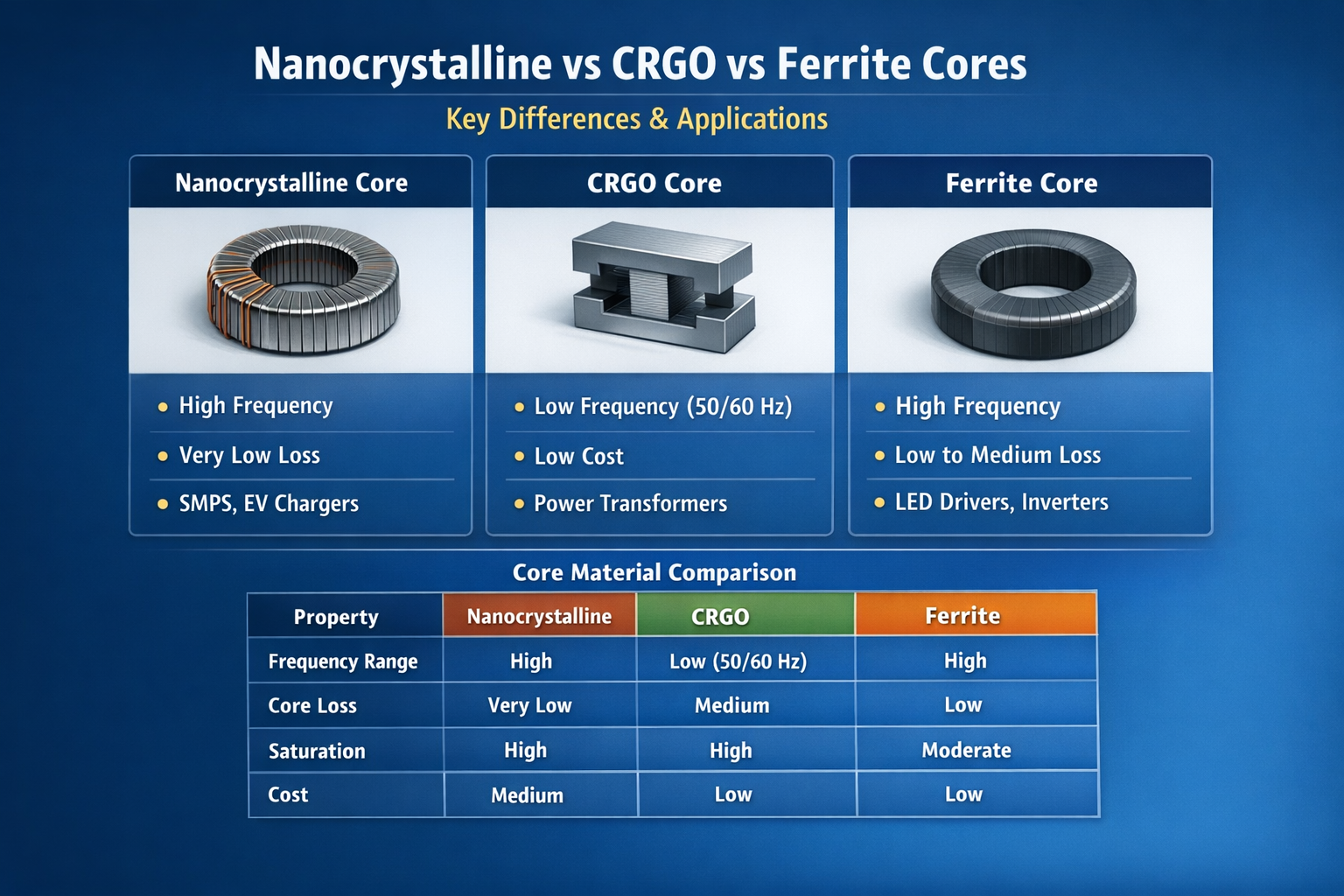
| Property | Nanocrystalline | CRGO Silicon Steel | Ferrite | Engineering Note |
|---|---|---|---|---|
| Saturation Flux Density (Bs) | 1.25T | 1.9T | 0.4T | Critical for fault current handling |
| Relative Permeability (μr) | 80,000-150,000 | 30,000-50,000 | 2,000-10,000 | Enables fewer turns, smaller cores |
| Core Loss @ 20kHz, 0.1T (W/kg) | <15 | >150 | 20-80 | Data based on CenturaCores lab testing using standard toroidal samples (OD 30mm x ID 20mm x HT 10mm) |
| Curie Temperature (Tc) | ~570°C | ~750°C | ~200°C | Ferrite loses properties in hot EV engine bays |
| Operating Frequency Range | 50Hz-100kHz | 50Hz-1kHz (limited by 0.23-0.35mm lamination) | 1kHz-1MHz+ | CRGO eddy currents increase with lamination thickness |
| Mechanical Properties | Brittle (needs casing) | Robust | Moderate | Affects assembly and reliability |
| Cost per kg (relative) | 10x | 1x | 3x | Relative $/kg vs CRGO. While nanocrystalline material cost is higher, fewer copper windings and a smaller enclosure often yield lower total system cost: model BOM + thermal + mechanics, not core $/kg alone. |
Real-world trade-offs
Nanocrystalline downsides
- • Brittle: typically needs protective packaging
- • Higher material cost vs CRGO
- • Narrower supplier base than ferrite steels
- • Saturation margin must be validated under fault
CRGO limitations
- • Loss rises rapidly with frequency
- • Large cores vs advanced high-μ kHz materials
- • Eddy currents limit switching applications
- • EMI performance differs from high-μ HF materials
Ferrite challenges
- • Low saturation vs metallic cores
- • Temperature-dependent properties (design margin)
- • Air gap and assembly sensitivity in some topologies
- • Weak choice for heavy low-frequency magnetics vs CRGO
Case study: 10 kW solar inverter redesign
Problem: Ferrite-based EMI filter was failing conducted emissions at 150 kHz.
Solution: Switched to nanocrystalline common-mode chokes.
Result: ~45% volume reduction, ~15 dB better attenuation, similar thermal profile. Material cost increased, but avoided a full enclosure redesign.
Nanocrystalline Core
When efficiency, loss, and volume actually matter at kHz
Nanocrystalline is usually the preferred choice when you need low core loss, compact magnetics, and strong permeability in the kHz window (think EV charger transformers, inverter magnetics, EMI/common-mode stages, and metering-grade CTs where ferrite would need more turns or copper and CRGO would simply cook).
- Trade higher material cost against copper, cooling, and enclosure size; on many programs the BOM and thermal story improve net.
- Delivers the linearity and low magnetizing burden that Class 0.2s CTs and tight filter attenuation demand, without the bulk of silicon steel at switching frequency.
If conducted or radiated EMC is failing, move from "generic choke" thinking to a part built for high-μ HF paths; see EMI filter cores and validate permeability vs frequency against your worst-case harmonics.
Explore nanocrystalline cores for SMPS, inverters, and CTsCRGO Core
The right tool for utility iron, not for switching supplies
CRGO is optimized for 50/60 Hz and massive kVA. It delivers the saturation and cost structure that distribution and power transformers still demand. It is generally a poor choice for high-frequency power electronics: laminated steel's eddy-current losses balloon with frequency, so using CRGO "because it worked on the grid" in an SMPS magnetics role burns power and thermals.
- High Bsat (~1.9 T) buys magnetic area at line frequency, which is why utilities stay on steel.
- Supply chain maturity and stamping/lamination know-how keep CRGO the default mains-frequency winner; leave kHz magnetics to nanocrystalline or ferrite.
Ferrite Core
The practical low-cost HF default until specs tighten
Ferrite is often the practical low-cost choice for mainstream SMPS: resistivity kills eddy losses at HF, and catalog shapes (E/EFD/RM/P/toroids) make winding repeatable. It becomes less attractive as power density and efficiency demands increase: low saturation forces higher turns, larger copper loss, or air-gapped architectures, and hot-spot temperature eats margin fast if you chase small volume.
- Pick ferrite first when standard SMPS flux/temperature budgets close comfortably and BOM cost leads.
- Re-evaluate toward nanocrystalline when you need fewer turns, lower loss at mid-kHz, or smaller magnetics without blowing saturation (common in high-power EV charging blocks and dense inverter magnetics).
When to Choose Each Core
Frequency-based starting point
Choose nanocrystalline when:
- • Efficiency, lower losses, compact magnetics, and stronger high-frequency performance are priorities: inverter and SMPS kHz stages, EV charger transformers, EMI stages, and CTs that fail on bulk or loss with steel or the wrong ferrite grade.
- • You are trading material $ for thermal headroom, window area, or enclosure volume and need vendor curves to prove loss at your Bpk/T.
Use CRGO only when:
- • The design is truly low-frequency (50/60 Hz), size is less critical, and cost matters more than compactness or high-frequency efficiency.
- • You are building utility-scale or large plant transformers where CRGO saturation and stamping economics beat every alternative (not when your dominant stress is switching frequency).
Use ferrite when:
- • Economical high-frequency magnetics for mainstream SMPS where power level and specs still fit ferrite: catalog shapes, known winding patterns, and saturation margin at Tj without a nanocrystalline cost step-up.
- • Your team can hold Bpk, gap, and hot-spot temperature inside the ferrite grade envelope; if those budgets are failing, nanocrystalline is the usual upgrade path, not CRGO.
Applications
Nanocrystalline: typical roles
- Current transformer (CT) cores for metering and protection
- EV charger transformers (typically 20–100 kHz)
- EMI filter and common‑mode choke cores
- High‑frequency power supplies operating in the kHz range
- Precision measurement equipment requiring low phase error and low magnetizing current
CRGO: typical roles
- Power and distribution transformers at 50/60 Hz
- Large industrial motors and generators
- Grid‑tied equipment operating at mains frequency
- High‑power, low‑frequency transformers (on the order of kVA to MVA)
Ferrite: typical roles
- Switch‑mode power supplies operating above ~100 kHz
- RF transformers and broadband inductors
- High‑frequency chokes and filter components
- Flyback and forward converters in telecommunications and computing equipment
FAQ
Which core has the lowest loss?
There is no universal winner: core loss depends on frequency, flux density, waveform, and temperature. At line frequency (50/60 Hz) with moderate flux, CRGO is typically very efficient. In the ~10–100 kHz range at practical flux levels, nanocrystalline often shows lower loss than CRGO (where CRGO eddy-current loss rises sharply) and can beat many ferrites in specific operating points. At hundreds of kHz and above, ferrite is usually the practical low-loss choice if peak flux is kept within saturation limits. Always compare loss curves at your actual Bpk and duty.
Which core is best for SMPS?
For mainstream isolated SMPS magnetics in the hundreds of kHz, ferrite is the default thanks to shapes, availability, and low HF loss when flux is controlled. For intermediate frequencies (roughly tens of kHz to ~100 kHz) or when you need very high permeability and compact magnetics (e.g., some LLC or filter stages), nanocrystalline is often preferred. CRGO is generally unsuitable as a main SMPS core material at switching frequencies due to excessive eddy-current loss. It remains the right choice for mains-frequency transformers and large line-frequency magnetics.
What is the difference between CRGO and ferrite?
CRGO is grain-oriented silicon steel with very high saturation (often ~1.9 T) and excellent economics for 50/60 Hz power transformers, but laminated steel performs poorly at high frequency due to eddy currents. Ferrite is a ceramic with much lower saturation (typically on the order of ~0.3–0.5 T depending on grade) but very high resistivity, so it stays efficient at high frequency in SMPS and filter applications. In short: CRGO wins at mains frequency and kVA scale; ferrite wins at switching frequency when you design within ferrite’s flux and thermal limits.
Can I use nanocrystalline for every application?
No. Nanocrystalline excels across a wide kHz window and can reduce size in CTs, EMI chokes, and many power-magnetic roles, but cost, mechanical brittleness (often requiring packaging), and saturation limits at extreme fault currents can make CRGO or ferrite the better system choice. Very large mains-frequency transformers are still dominated by CRGO on cost and robustness.
Bottom line
- • Nanocrystalline: choose it for high efficiency, low loss, and compact high-performance kHz magnetics (dense SMPS/inverter/EV charger work, demanding CTs, EMI where size and loss dominate).
- • CRGO: choose it for traditional low-frequency transformer applications at real kVA/MVA where line-frequency steel still wins on saturation and cost.
- • Ferrite: choose it for lower-cost high-frequency designs where standard SMPS flux and thermal budgets still close; when they do not, escalate to nanocrystalline. Do not force CRGO into switching cores.
Need Help Choosing the Right Core?
Not sure which core fits your design? We recommend the right material, size, and configuration from your operating frequency, power level, thermal limit, and application, so you don't leave loss and heat on the table.
Tell us what you are building: transformers, SMPS, EV chargers, current transformers, or custom inverter magnetics. We will align core class (nanocrystalline vs ferrite vs line-frequency steel) with measured expectations, not catalog marketing.