China vs India Nanocrystalline Cores: Technical Performance, Supply Chain Risk, and Supplier Qualification Guide (2026)
Quick Answer:
Choosing between China and India for nanocrystalline cores is rarely a binary decision. China offers extensive capacity and mature supply networks; India offers diversification and geographic redundancy. The strongest sourcing programs qualify suppliers in both regions and compare them on the same six criteria:
- Technical performance (permeability, core loss, inductance factor AL)
- Manufacturing capacity and scalability
- Lead-time stability and logistics flexibility
- Traceability and country-of-origin documentation
- Regulatory compliance for regulated programs
- Engineering support during development and qualification
For many OEMs, supply chain resilience is now evaluated alongside traditional magnetic performance parameters. This guide combines engineering, procurement, and compliance criteria so you can qualify nanocrystalline core suppliers with confidence.
Why Supply Chain Risk Has Become an Engineering Concern
Historically, engineers selected magnetic materials based on performance characteristics such as permeability, saturation flux density, core loss, and thermal stability. Procurement teams focused on cost and lead time, while engineering teams focused on electrical performance.
That separation is becoming increasingly difficult to maintain.
As electric vehicles, renewable energy systems, industrial automation, smart metering, and data center infrastructure continue to scale, component availability has become a critical design consideration. A current transformer, common-mode choke, or pulse transformer may satisfy every electrical requirement during qualification testing, yet still create production challenges if supply becomes constrained during volume manufacturing.
For many OEMs, supply chain resilience is now evaluated alongside traditional magnetic performance parameters.
Understanding the Nanocrystalline Core Supply Chain
Nanocrystalline cores pass through several distinct manufacturing stages before reaching the end customer.
Stage 1 - Ribbon Production
Nanocrystalline ribbon is produced through rapid solidification of iron-based alloys, creating an amorphous precursor ribbon typically measuring approximately 20–35 µm in thickness.
Stage 2 - Core Winding and Annealing
The ribbon is slit, wound into toroidal or custom geometries, and subjected to controlled annealing processes. Annealing conditions significantly influence final permeability, linearity, and core loss performance.
Stage 3 - Finishing and Packaging
Finished cores may be supplied as:
- Bare wound toroids
- Plastic-cased toroids
- Epoxy-coated cores
- Split-core assemblies
- Custom current transformer assemblies
Quality control, dimensional inspection, and inductance verification typically occur during this phase.
Because each stage affects final performance, evaluating a supplier requires more than reviewing a material datasheet.
Key Engineering Parameters That Matter
When comparing nanocrystalline core suppliers, engineers should focus on measurable parameters rather than marketing terminology.
Initial Permeability
High initial permeability allows efficient operation in current sensing, EMI suppression, and low-level signal applications. Typical high-permeability nanocrystalline materials achieve:
However, the published permeability value alone is not sufficient. Engineers should also evaluate lot-to-lot consistency and production repeatability.
Saturation Flux Density
One of nanocrystalline technology's primary advantages is its high saturation flux density.
This allows smaller magnetic designs and greater tolerance to transient current events compared with many traditional ferrite materials.
Core Loss Performance
For high-frequency power conversion applications, core loss directly affects system efficiency and thermal management requirements. Core-loss evaluation should be performed under application-relevant conditions, including:
- Frequency range
- Flux density
- Operating temperature
- Waveform type
Datasheet values obtained under different test conditions should not be compared directly.
Inductance Factor (AL)
The inductance factor remains one of the most important production quality indicators.
Significant AL variation may indicate differences in:
- Annealing processes
- Mechanical stress
- Material consistency
- Measurement methodology
When qualifying suppliers, engineers should request statistical AL data across multiple production batches rather than relying on a single sample value.
China and India: Understanding the Supply Chain Differences
China remains one of the world's largest ecosystems for magnetic materials, offering extensive manufacturing capacity and mature supply networks.
India has emerged as an increasingly important alternative manufacturing location, particularly for organizations seeking supply chain diversification and geographic redundancy.
Rather than viewing sourcing decisions as a choice between one country and another, many OEMs now adopt a dual-sourcing strategy designed to reduce concentration risk.
Comparative Considerations
| Evaluation Area | Questions to Ask |
|---|---|
| Technical Performance | Can the supplier consistently meet AL, permeability, and core-loss requirements? |
| Manufacturing Capacity | Can production scale during demand increases? |
| Lead-Time Stability | How predictable are delivery schedules? |
| Traceability | Are material and process records available? |
| Compliance | Can required country-of-origin documentation be provided? |
| Engineering Support | Is technical assistance available during development and qualification? |
The strongest suppliers perform well across all categories rather than excelling in only one.
Regulatory and Compliance Considerations
For certain industries, sourcing decisions extend beyond engineering requirements. Applications involving:
- Utility infrastructure
- Government-funded projects
- Defense-adjacent systems
- Aerospace programs
- Critical industrial infrastructure
may require additional documentation and sourcing transparency. Examples can include:
- Certificate of Origin documentation
- Material traceability records
- Supplier quality documentation
- Regulatory compliance reporting
Organizations should verify requirements early in the qualification process to avoid redesigns or procurement delays later in the product lifecycle.
The Hidden Cost of Supply Interruptions
Component cost often receives significant attention during supplier selection. However, the financial impact of a production interruption frequently exceeds savings achieved through lowest-cost sourcing.
Consider a manufacturer producing:
- EV charging equipment
- Solar inverters
- Industrial drives
- Smart metering systems
A delayed magnetic component shipment may affect:
- Production schedules
- Customer deliveries
- Revenue recognition
- Contractual obligations
- Inventory planning
For this reason, many organizations evaluate supply continuity alongside unit pricing when developing sourcing strategies.
A Practical Supplier Qualification Framework
Before approving any nanocrystalline core supplier, consider four areas.
1. Technical Validation
Verify:
- Permeability
- AL tolerance
- Core loss
- Saturation performance
- Thermal stability
Testing should be conducted using production-intent samples rather than prototype-only lots.
2. Manufacturing Assessment
Evaluate:
- Production capacity
- Process controls
- Annealing consistency
- Quality systems
- Inspection procedures
3. Supply Chain Evaluation
Review:
- Lead times
- Inventory support
- Geographic concentration risk
- Logistics flexibility
- Alternate production capability
4. Commercial Support
Assess:
- Engineering responsiveness
- Documentation quality
- Customization capabilities
- Long-term partnership potential
This structured approach often identifies risks that are not visible through datasheet comparisons alone.
Applications Driving Demand for Nanocrystalline Cores
Demand continues to grow across several industries:
Electric Vehicles and Charging Infrastructure
Applications include:
- Current sensing
- Leakage current detection
- EMI suppression
- Onboard chargers
- Fast-charging systems
Renewable Energy
Nanocrystalline cores are commonly used in:
- Solar inverters
- Wind power converters
- Energy storage systems
- Grid interface equipment
Smart Metering and Grid Automation
Utilities increasingly require high-performance magnetic components for:
- Revenue metering
- Residual current detection
- Power quality monitoring
- Grid protection systems
Industrial Automation
Applications include:
- Power supplies
- Motor drives
- Industrial control systems
- High-frequency transformers
The Future of Nanocrystalline Core Sourcing
The industry's direction is not toward replacing one manufacturing region with another. Instead, leading OEMs increasingly focus on building resilient supply networks that combine:
- Qualified primary suppliers
- Qualified secondary suppliers
- Regional inventory strategies
- Strong technical partnerships
This approach reduces risk while preserving flexibility as market conditions evolve.
Organizations that integrate supply chain considerations during the engineering phase are often better positioned to scale production, manage disruptions, and support long-term product growth.
Frequently Asked Questions
Should I source nanocrystalline cores from China or India?
It is rarely a binary choice. China offers extensive capacity and mature supply networks, while India provides geographic diversification and redundancy. Most OEMs now adopt a dual-sourcing strategy that qualifies suppliers in both regions to reduce concentration risk, then compares them on technical performance, capacity, lead-time stability, traceability, compliance, and engineering support.
What technical parameters matter most when qualifying a supplier?
Focus on measurable parameters: initial permeability (high-permeability materials reach μi ≥ 140,000), saturation flux density (Bsat ≈ 1.25 T), core loss under application-relevant frequency, flux density, temperature and waveform, and inductance factor AL where L = N2 × AL. Request statistical data across multiple production batches rather than a single sample value.
Why is supply chain risk now an engineering concern?
As EVs, renewable energy, industrial automation, smart metering, and data centers scale, component availability has become a design consideration. A core that passes every electrical requirement during qualification can still create production challenges if supply becomes constrained at volume. Many OEMs now evaluate supply resilience alongside permeability, saturation, and core loss.
What documentation should I request for regulated programs?
For utility infrastructure, government-funded, defense-adjacent, aerospace, and critical industrial programs, request Certificate of Origin documentation, material traceability records, supplier quality documentation, and regulatory compliance reporting. Verify these requirements early to avoid redesigns or procurement delays.
How costly is a magnetic component supply interruption?
The financial impact of a production interruption frequently exceeds the savings from lowest-cost sourcing. A delayed core shipment can affect production schedules, customer deliveries, revenue recognition, contractual obligations, and inventory planning. Many organizations weigh supply continuity alongside unit pricing.
About Centura Cores
Centura Cores supplies nanocrystalline cores, amorphous cut cores, and ferrite magnetic components for power electronics, energy infrastructure, industrial automation, and metering applications.
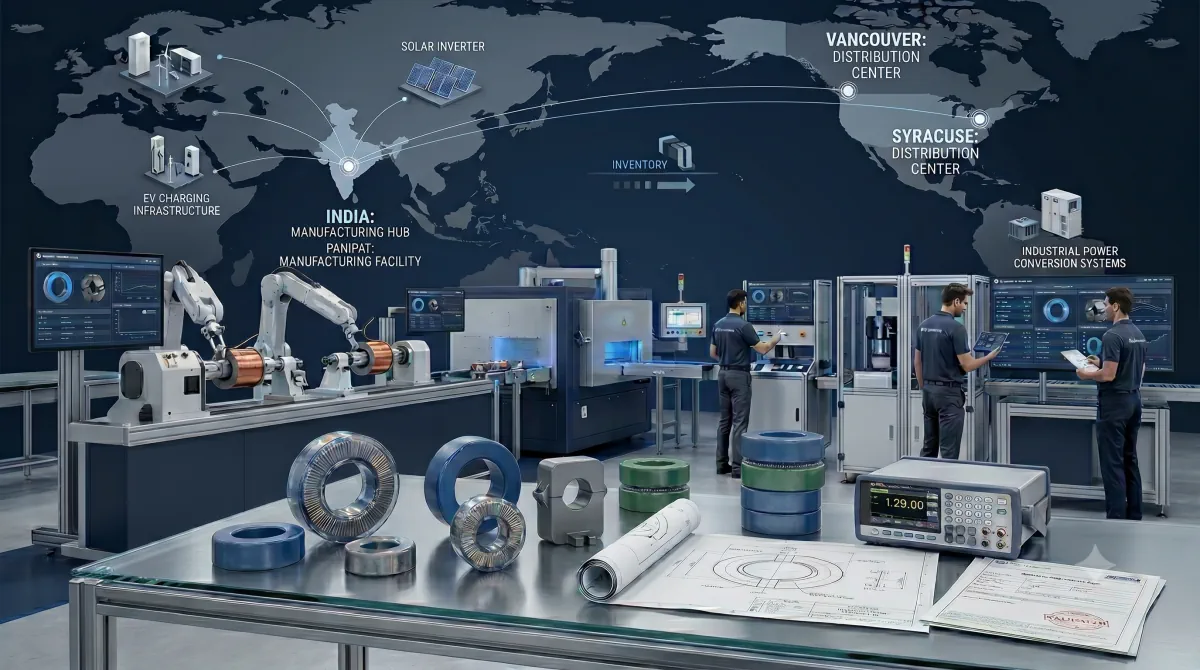
With manufacturing operations in India and customer support serving North American markets, Centura Cores helps OEMs develop qualified magnetic solutions from prototype development through volume production.
For engineering assistance, material selection guidance, sample evaluation, or custom magnetic component development, contact the Centura Cores technical team.
Qualify a Dual-Source Supplier
Get engineering and compliance support to qualify nanocrystalline cores for volume production.
Contact EngineersRequest a Sourcing Quote
Compare pricing, lead times, and country-of-origin documentation for your cores.
Get QuoteFree Sample Program
Validate core quality and performance with production-intent samples. Our engineering team guides the evaluation process.
Request Samples